
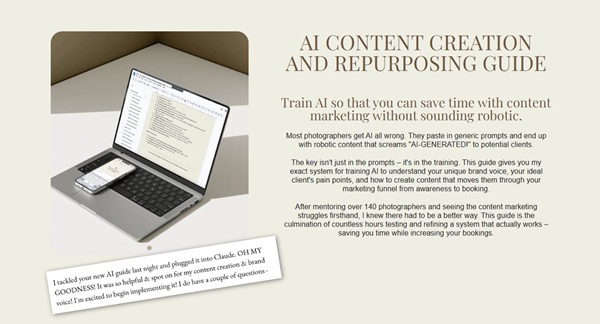
The modern photography landscape demands more than just stunning visuals; it requires compelling narratives and consistent engagement. Navigating this digital space can feel overwhelming, leading many creatives to seek technological solutions. This article serves as an essential AI Content Creation Guide, delving into how photographers can harness artificial intelligence not just to streamline their marketing, but to amplify their unique brand identity and connect deeply with their ideal clientele.
AI Content Creation Guide
The prevalent struggle within the photography industry concerning content marketing is not a question of talent or artistic vision, but rather a systemic issue rooted in inefficient methodologies. Many photographers find themselves dedicating an inordinate amount of time to marketing efforts, often feeling as though it constitutes a full-time job in itself, thereby detracting from their core passions: shooting and editing. This challenge manifests in several critical pain points. Creative stagnation is a pervasive problem, characterized by hours spent staring at a blank screen, wrestling with words, or endlessly rewriting the same generic phrases, leading to a frustrating cycle of uninspired output. This lack of fresh ideas and compelling language directly contributes to a profound lack of differentiation. Photographers often resort to producing captions that are indistinguishable from their competitors, such as simple “[Photographer Name] at [Venue]” announcements, which fail to articulate their unique value proposition or connect with potential clients on an emotional level.

The sheer time intensity of creating high-quality content also leads to significant inefficiency and inconsistency. During peak seasons, when demand is highest, marketing efforts often fall by the wayside, resulting in sporadic posting schedules that fail to maintain audience interest or momentum. This inconsistency is mirrored in the low engagement rates many experience; their content simply fails to resonate, leading to the dreaded “crickets” phenomenon. Ultimately, this disconnect translates into lost revenue, as missed opportunities for bookings arise from an inconsistent marketing presence and a failure to forge genuine connections with their target audience. The promise of AI has often been touted as a solution, yet its application has frequently fallen short, creating a new set of problems rather than solving old ones.
The Crisis of Generic Content and the AI Promise
The current state of AI adoption in content marketing for photographers is widely recognized as problematic, often leading to outcomes that are counterproductive to genuine brand building. The core issue stems from an over-reliance on generic prompting, a method that treats AI as a simple text generator rather than a sophisticated tool requiring nuanced direction. When photographers input broad, unspecific prompts into AI models, the output invariably reflects this lack of specificity. The resulting content often feels robotic, devoid of personality, and utterly fails to capture the unique essence of the photographer’s brand or the emotional nuances of their work. This generic output becomes a signal to potential clients that the photographer is not deeply invested in their brand or their audience’s needs, leading to a sense of detachment rather than connection.
Instead of building trust and perceived authenticity, this robotic content can actively alienate prospective clients, pushing them towards competitors who may have a more human and relatable online presence, even if their visual work is comparable. This isn’t a failure of artificial intelligence technology inherently, but rather a failure in how it is implemented. The technology itself is capable of remarkable feats, but its effectiveness is entirely dependent on the quality of the input and the strategic framework guiding its use. The perceived shortcomings are not a reflection of AI’s limitations, but of the user’s approach, highlighting a critical need for a more sophisticated understanding of how to leverage these powerful tools. The allure of quick content generation through simple prompts has blinded many to the deeper potential, trapping them in a cycle of producing more, yet less effective, marketing materials.
This reliance on superficial AI interaction misses the fundamental objective: creating content that speaks directly to the client’s heart and mind. Photographers are artists, storytellers, and memory keepers. Their marketing should reflect this. Generic AI outputs, however, are essentially hollow shells, lacking the soul and specificity that defines a successful brand. They fail to address the intricate desires, fears, and aspirations that drive clients to invest in professional photography. For instance, a wedding photographer isn’t just selling photos; they’re selling peace of mind for the couple, the preservation of fleeting moments, and the creation of heirlooms.
Generic captions miss this entirely. They don’t acknowledge the anxiety of planning a wedding, the joy of seeing one’s vision come to life, or the desire to capture genuine emotion. The AI promise was to alleviate the burden of content creation, freeing up photographers to focus on their craft. However, when used improperly, it becomes another source of frustration, producing content that requires extensive editing to even approach authenticity, thus negating the intended time-saving benefits. The challenge, therefore, is to move beyond the superficial application of AI and embrace a methodology that allows it to become a genuine extension of the photographer’s voice and strategy. This requires a paradigm shift in how AI is viewed and utilized within the creative marketing workflow.
Redefining AI Implementation-From Prompting to Training
The stark contrast between generic AI outputs and truly effective marketing content highlights a fundamental misunderstanding of how to integrate AI into a professional workflow. The assertion is clear: the secret to authenticity and effectiveness lies not in the cleverness or complexity of individual prompts, but in the foundational training phase. Generic prompting is akin to asking a highly skilled chef to cook a meal with only a vague instruction like “make food.” The result will be edible, perhaps, but unlikely to be a culinary masterpiece tailored to specific tastes or dietary needs. Similarly, generic prompts deliver generic text.
The true power of AI Content Creation Guide principles is unlocked when the AI is systematically trained to internalize the photographer’s unique brand voice, understand their ideal client’s specific pain points, and align with the overarching marketing funnel. This training process involves more than just a few initial commands; it requires a comprehensive system designed to imbue the AI with the photographer’s ethos, values, and client-centric approach. It’s about teaching the AI who the photographer is, who they serve, and how they solve problems for those clients. This shift from simple prompting to deep AI training transforms the technology from a mere text-generating machine into a strategic marketing partner capable of producing deeply resonant and conversion-focused content.
This training methodology moves beyond the superficial “robotic signal” that potential clients can easily detect. When content feels mass-produced and impersonal, it erodes brand trust and diminishes the perceived authenticity of the photographer. A well-trained AI, however, can produce content that sounds remarkably human, reflecting the photographer’s personality, values, and unique selling propositions. The goal of integration is not to automate creativity out of existence, but to automate the process of content generation in a way that amplifies human intelligence and artistic intent. This involves training the AI not just on words, but on the underlying strategy.
It should understand the marketing funnel: how to attract potential clients initially (awareness), how to engage them and demonstrate value (consideration), and ultimately, how to persuade them to book services (decision). By embedding this strategic understanding into the AI’s operational framework, content can be generated that actively guides clients through their buyer journey, addressing their needs and concerns at each stage. This is where the true potential of AI in marketing lies – not in replacing the human touch, but in enhancing it, making it more consistent, more efficient, and more impactful. It requires a commitment to a more rigorous, systematic approach, moving away from quick fixes and towards sustainable, strategic AI integration that truly serves the business’s growth objectives by fostering deeper client relationships.
The fallacy of generic AI usage becomes apparent when one considers the desired outcome of content marketing: building relationships and driving conversions. If AI-generated content does not sound like the photographer, does not speak to the client’s deepest needs, and does not guide them towards a booking, then it has failed its primary purpose. The solution lies in recognizing that AI is a powerful tool that requires skilled operation. Just as a photographer meticulously crafts their camera settings, lighting, and composition to achieve a specific artistic vision, they must also meticulously “craft” their AI by providing it with the right information and strategic direction.
This involves a deep dive into what makes the photographer unique, what their clients truly seek, and how their services provide solutions. The AI then acts as an incredibly efficient and tireless assistant, capable of translating this deep understanding into a constant stream of authentic, engaging, and strategically aligned content. This approach transforms AI from a potential liability into an invaluable asset, capable of generating a week’s worth of on-brand captions in under an hour, and seamlessly repurposing single content pieces across multiple platforms. It’s a sophisticated evolution of marketing practice, one that honors both the creative spirit of the photographer and the complex dynamics of client acquisition in the digital age.
The AI-Assisted Workflow-Efficiency and Authenticity Merged
When artificial intelligence is correctly trained and integrated into a photographer’s marketing workflow, the results are transformative, addressing many of the core pain points that plague creative professionals. The most immediate and tangible benefit is a dramatic increase in efficiency and a significant reclamation of time. The laborious process of brainstorming, drafting, and refining social media captions, blog posts, and email newsletters can be reduced from hours or even days down to mere minutes. Imagine being able to generate an entire week’s worth of engaging, on-brand social media captions in under an hour. This level of efficiency is not about cutting corners; it’s about leveraging technology to do the heavy lifting, freeing up the photographer’s valuable time and mental energy. This reclaimed time can be reinvested into creative pursuits, client relationships, or simply personal well-being, alleviating the burnout associated with the constant demand for fresh content. The impact on consistency is equally profound. Even during the busiest wedding seasons or when juggling multiple client projects, a well-trained AI system can ensure a steady, professional presence across all marketing channels. This means no more sporadic posting or radio silence, maintaining audience engagement and keeping the business top-of-mind for potential clients.
Beyond mere efficiency, the strategic integration of AI fundamentally enhances brand and audience impact by fostering authentic connections. Content generated through a properly trained system sounds like the individual photographer, not a generic chatbot. It reflects their unique voice, their personality, and their perspective, making it far more likely to resonate with their target audience. This authenticity is key to building trust and fostering deeper engagement. When potential clients feel they “know” the photographer through their content, they are more likely to feel a personal connection, which is often the deciding factor in booking. Furthermore, AI can be trained to understand the marketing funnel systematically. Prompts and generated content can be designed to move potential clients from initial awareness through consideration and towards the decision to book, addressing their specific questions and concerns at each stage. This strategic positioning ensures that marketing efforts are not just broadcasting messages, but actively guiding prospects towards conversion. The shift in confidence is also a significant outcome. For many photographers, content creation has been a stressful chore, a constant source of anxiety. By implementing an efficient and effective AI system, this perception can change entirely. Marketing can become an easy, even fun, part of the business that works autonomously for the creator, boosting morale and allowing them to focus on what they do best.
The seamless repurposing of content is another powerful facet of this integrated workflow. A single, high-value piece of content, such as a blog post detailing a client’s wedding day experience or a guide on choosing the right portrait session, can be intelligently transformed into a multitude of formats for different platforms. This means a single blog post can be broken down into Instagram carousel slides, individual social media captions, Pinterest pins, email newsletter snippets, and even short video script ideas. This strategy maximizes the reach and impact of every piece of content created, ensuring that valuable insights and brand messaging are consistently delivered across diverse channels without requiring the creation of entirely new material from scratch. It’s a sophisticated approach to content marketing that leverages AI to amplify every effort, turning a single investment of time into a multi-platform content series. This integrated approach, combining rigorous AI training with strategic workflow design, ensures that marketing efforts are not only efficient but also deeply personal, consistently engaging, and ultimately, highly effective at driving bookings and growing the photography business. It represents a fundamental evolution in how photographers can approach their online presence, turning a perceived burden into a powerful engine for growth.
Claire Hunt – Revolutionizing Photographer Marketing
The systemic struggle photographers face with content marketing is often attributed to a lack of an efficient system, rather than a personal failing. This is precisely where the methodology proposed by Claire Hunt steps in, offering a powerful, refined solution that moves beyond the superficial and tackles the root causes of marketing inefficiency. Hunt’s approach is grounded in years of experience and refinement, having mentored over 140 photographers, distilling complex marketing challenges into a tangible, actionable system. The core of her methodology lies in a profound understanding that the AI is not a magic wand to be waved with generic prompts, but a sophisticated tool that requires deliberate, strategic training.
This training focuses on imbuing the AI with the photographer’s unique brand voice, deeply understanding the specific pain points of their ideal clientele, and aligning content creation with conversion goals. This strategic AI training system aims to transform content creation from a time-consuming burden into a streamlined, conversion-focused engine. The key outcomes are revolutionary: the ability to generate a week’s worth of on-brand captions in under an hour, and the seamless repurposing of single content pieces across multiple platforms, a feat previously requiring extensive manual effort. This is not just about using AI; it’s about mastering an AI Content Creation Guide framework that ensures authenticity, efficiency, and tangible business results.
The genesis of Claire Hunt‘s methodology is rooted in observing and addressing the granular challenges faced by photographers in their day-to-day marketing efforts. She recognized that the prevalent “full-time job mentality” applied to marketing was unsustainable and detrimental to the core business. Photographers were sacrificing shooting and editing time, their primary revenue-generating activities, to wrestle with content creation that yielded minimal results. The identified pain points – creative stagnation, lack of differentiation, inefficiency, inconsistency, low engagement, and lost revenue – were not isolated incidents but symptoms of a systemic problem. Hunt’s work aims to provide a systemic solution, one that leverages cutting-edge technology but anchors it firmly in strategic marketing principles and authentic brand representation. Her focus on comprehensive AI training, rather than mere prompting, is the critical differentiator.
This involves a multi-faceted approach that educates and guides the AI to mirror the photographer’s unique way of speaking, thinking, and connecting with clients. By teaching the AI to understand the specific anxieties, desires, and aspirations of potential clients—those who are actively seeking photography services—the generated content becomes inherently more relevant and persuasive. This strategic depth ensures that marketing efforts are not just about filling a social media feed, but about actively nurturing leads, building trust, and guiding prospects towards making a booking. Claire Hunt‘s system represents a paradigm shift, empowering photographers to regain control of their marketing narrative and transform it into a powerful engine for business growth.
The Genesis of Claire Hunt’s Strategic AI Framework
The foundation of Claire Hunt‘s revolutionary approach is built upon a deep understanding of the photographer’s plight in the digital age. She observed that the perceived failure of AI in content marketing wasn’t a technological deficiency, but a critical flaw in implementation. Many photographers were treating AI as a magic button, expecting miraculous results from simplistic prompts. This led to the widespread issue of generic, robotic content that failed to capture the essence of their brand or connect with potential clients on a meaningful level. Hunt recognized that for AI to be a true asset, it needed to be trained, not just prompted. This realization marked the genesis of her strategic AI framework, which shifts the focus from superficial interaction to a profound, data-driven educational process for the AI model.
Her methodology is the product of rigorous testing and refinement, honed through the direct mentoring of over 140 photographers, each bringing their unique brand and client challenges. This hands-on experience allowed her to identify the core components necessary to transform AI from a potential liability into an indispensable marketing partner. The goal was to create a system that could take the photographer’s unique voice, their client’s specific needs, and their business objectives, and weave them into a cohesive, effective content strategy. This framework is designed to empower photographers, enabling them to produce authentic, engaging, and conversion-focused content with unprecedented efficiency, thus mitigating the “content creation crisis” that plagues so many creative entrepreneurs.
This strategic framework is not about creating a superficial veneer of personality; it’s about deeply embedding the photographer’s unique brand identity into the AI’s operational DNA. It involves understanding that each photographer has a distinct way of communicating, a specific set of values they embody, and a particular understanding of their ideal client’s world. Hunt’s system guides photographers through the process of articulating these elements to the AI. This might involve analyzing their existing client testimonials, identifying recurring themes in their conversations, or defining their core brand voice through descriptive adjectives. The AI, once trained on this rich, specific data, can then generate content that genuinely reflects the photographer’s personality, making it feel personal and authentic to the audience.
This is the antithesis of generic AI output. It’s about building a digital extension of the photographer’s professional persona that communicates effectively and persuasively. The emphasis is on creating content that doesn’t just inform but connects, building rapport and trust that ultimately drives bookings. This systematic training process ensures that every piece of content generated serves a strategic purpose, moving beyond mere aesthetic appeal to actively contribute to business growth by fostering deeper client relationships and clearly articulating the photographer’s value proposition in a way that resonates with their target market. It’s a holistic approach that bridges the gap between artistic talent and effective business development.
The core philosophy behind Claire Hunt‘s framework is that AI should amplify, not replace, the photographer’s unique strengths. Instead of asking AI to “write like a photographer,” the system trains AI to “write like you, the photographer, for your ideal client.” This nuanced distinction is crucial. It means the AI learns the specific vocabulary, tone, and stylistic preferences that define the photographer’s brand. It also learns to identify and address the specific pain points of their ideal clientele—the anxieties they experience, the desires they hold, and the problems they need solved.
This deep client understanding is what makes AI-generated content truly effective, moving it from generic messaging to personalized communication that feels understood and valued by the recipient. The framework is designed to be comprehensive, providing photographers with the tools and methodologies to ensure their AI-generated content is not only on-brand but also strategically aligned with their business goals. It addresses the inherent inefficiency of manual content creation by automating the generation process, allowing for a week’s worth of high-quality, personalized content to be produced in under an hour. This revolutionizes the workflow, transforming content marketing from a time-consuming burden into an efficient, conversion-focused engine.
Deconstructing the System-Key Training Components
Claire Hunt‘s strategic AI training system is meticulously designed with several core components, each serving a distinct yet interconnected purpose in creating authentic, conversion-focused content. At its heart is the Complete AI Training Document. This is not a set of generic prompts, but a detailed, step-by-step guide that ensures the AI internalizes the photographer’s unique brand voice. It provides the structured instructions needed for the AI to adopt the photographer’s specific tone, vocabulary, and stylistic nuances, effectively teaching the AI to “speak” like the photographer.
This document is the bedrock upon which all subsequent content generation is built, ensuring consistency and authenticity across every output. Following this foundational training are specific prompt categories designed to foster deep client connection and position the photographer strategically. The Problem-Awareness Prompts are a crucial element, comprising over ten distinct prompts. These are crafted to make potential clients feel deeply understood by highlighting their specific struggles, fears, and hesitations related to photography services. By acknowledging and articulating these pain points, the photographer’s brand immediately establishes empathy and relevance.
Complementing the problem-awareness are the Solution-Based Prompts. These also number over ten and are designed to position the photographer as the expert guide capable of effectively solving the client’s identified needs. They articulate the photographer’s unique approach, process, and the tangible benefits they offer, demonstrating how their services directly address the client’s challenges. This dual approach—acknowledging problems and presenting solutions—is fundamental to guiding potential clients through the marketing funnel. Furthermore, Values-Based Prompts are integrated to create deeper emotional connections. These prompts focus on aligning the photographer’s core values with those of their ideal clientele, fostering a sense of shared identity and purpose.
This resonates with clients on a more profound level than transactional messaging, building loyalty and strengthening brand affinity. The system also includes a robust Content Repurposing System. This methodology is designed to transform a single piece of content, such as a comprehensive blog post, into multiple formats suitable for diverse platforms like Instagram, Pinterest, blogs, and email newsletters. This maximizes the reach and impact of every content creation effort, ensuring consistent messaging across all channels without starting from scratch each time. Finally, a Content Quality Checklist serves as a final verification step. This ensures that all generated content remains human-sounding, perfectly brand-aligned, and consistently conversion-focused, acting as a quality control mechanism before publication.
These components work in synergy to create a powerful AI Content Creation Guide that is both technically sophisticated and deeply human-centered. The emphasis on training, rather than simple prompting, ensures that the AI becomes an extension of the photographer’s authentic voice. For instance, the Problem-Awareness Prompts might be trained on common anxieties couples express before a wedding photoshoot—concerns about looking awkward, feeling uncomfortable in front of the camera, or worrying about capturing all the crucial moments. The AI, having learned these specific pain points, can then generate captions that start with empathetic statements like, “Are you worried you won’t feel natural in front of the camera on your wedding day?” or “Feeling overwhelmed trying to capture every precious moment that matters most?” This immediately signals to the reader that the photographer understands their concerns intimately.
The Solution-Based Prompts then offer reassurance and demonstrate expertise, perhaps with phrases like, “My approach is designed to make you feel relaxed and confident, ensuring your genuine emotions shine through,” or “I specialize in capturing the candid, heartfelt moments that tell your unique story, so you can relive them for a lifetime.” The Values-Based Prompts further cement this connection by highlighting shared perspectives on family, legacy, or the importance of authentic experiences, reinforcing why this particular photographer is the right fit for this particular client. This layered approach, facilitated by Claire Hunt‘s systematic training, turns AI from a generic tool into a personalized marketing powerhouse.
The Tangible Impact-Bridging the Gap to Bookings
The strategic benefits and desired outcomes outlined within Claire Hunt‘s AI Content Creation Guide framework are not theoretical; they represent tangible shifts that directly impact a photography business’s bottom line and overall operational health. The most immediate impact is observed in Efficiency and Scalability. The time reclamation is profound. As mentioned, the ability to generate a week’s worth of content in under an hour is a game-changer, freeing up countless hours previously lost to the drudgery of content creation. This is not a marginal improvement; it’s a fundamental shift in workflow. Effortless repurposing of content is another significant efficiency gain. Turning a single blog post into an entire content series across platforms like Instagram, Pinterest, and email newsletters without starting from scratch saves immense time and ensures consistent messaging. This allows photographers to maintain a robust and professional presence, even during high-workload seasons, overcoming the inconsistency that often plagues creative businesses. This sustained visibility is crucial for lead generation and nurturing.
The impact on Brand and Audience is equally transformative. The core promise of the system is to produce content that sounds like the individual photographer, rather than a sterile machine. This authentic connection leads to increased audience engagement because people connect with people, not algorithms. When content feels personal, it fosters trust and relatability. Furthermore, the AI’s ability to strategically position the photographer using tailored prompts ensures that clients are systematically moved through the marketing funnel. This means content isn’t just being published; it’s actively working to educate prospects, alleviate concerns, and build desire for the photographer’s services. This strategic communication is far more effective than generic advertising. For the photographer, there’s a profound increase in Confidence in Marketing. The perception of content creation shifts from a stressful, time-consuming chore to an easy, even enjoyable, part of the business that works autonomously. This psychological shift is invaluable, reducing burnout and allowing photographers to focus on their creative passion with renewed energy. The ultimate outcome is directly tied to business growth: a more consistent, authentic, and engaging marketing presence naturally leads to more inquiries and, crucially, more bookings. The system’s focus on conversion-oriented messaging, built upon a deep understanding of client pain points and desires, ensures that the generated content is not just seen, but acted upon.
This comprehensive system effectively bridges the gap between capturing beautiful images and translating that artistry into a thriving business. The frustration of “hello crickets” is replaced by meaningful interactions, as content resonates deeply with the intended audience. The lost revenue associated with inconsistent marketing or failing to connect is mitigated by a steady stream of on-brand, client-focused communication. For example, a wedding photographer trained with this system might use AI to
AI Content Creation Guide
The AI Content Creation Guide is an indispensable resource designed to navigate the multifaceted world of digital content generation, particularly for creative professionals such as photographers. This guide encompasses an intricate web of strategies, tools, and frameworks that enable users to amplify their business presence and engage their target audience effectively. By harnessing advanced AI technologies, creative individuals can streamline their content development processes, personalize their messaging, and ultimately drive more bookings.
In this guide, the architecture of successful content creation spans various dimensions—from understanding audience needs to effectively using AI to generate empathetic and relatable content. The principles outlined are not merely technical but focus on crafting authentic narratives that resonate on a human level. Success in the digital space necessitates that content transcends traditional promotional messages to foster genuine relationships, instilling trust and community. This unique approach to content creation is detailed comprehensively within this guide, allowing photographers to align their personal artistry with strategic marketing initiatives.
Understanding Your Audience: The Key to Impactful Content
The foundation of an effective content strategy is knowing your audience in depth. This means stepping into their shoes and truly comprehending their pain points, desires, and motivations. An AI-driven approach can significantly enhance this understanding by analyzing vast datasets that reveal patterns in audience behaviors and preferences. As a photographer, leveraging this insight enables you to tailor your messaging to address the specific anxieties and desires of potential clients.
An AI Content Creation Guide introduces the concept of audience segmentation, breaking down your target groups into niches. For instance, a wedding photographer may identify different personas: the anxious bride, the budget-conscious couple, or the adventurous elopement clients. Each segment has distinct concerns and aspirations, necessitating unique messaging strategies. By utilizing AI to generate content that speaks directly to these personas, photographers can cultivate stronger emotional connections. When potential clients feel understood, they are far more likely to engage with your content and pursue a booking.
Moreover, the art of storytelling is central to connecting with an audience. With AI, photographers can craft narratives that don’t just sell a service but tell a relatable story. For example, an empathetic narrative detailing the wedding journey, including the anticipation and moments of vulnerability, can make clients see themselves in those scenarios. This emotional engagement can spark interest and drive inquiries—not just as potential clients seeking photographic services, but as individuals yearning for a meaningful experience.
Leveraging AI for Content Creation Efficiency
A pivotal element of the AI Content Creation Guide is the introduction of automated systems that elevate productivity, particularly for busy photographers who rely on consistent social media engagement. The integration of AI technology into your workflow dramatically reduces the time spent on content creation, enabling you to focus on your passion for photography.
Imagine having the capability to generate a week’s worth of social media posts within mere minutes. AI-based tools can analyze previous content and audience dynamics, suggesting potential post ideas that align with seasonal themes, trending topics, or even client testimonials. By automating these suggestions, you’re not merely saving time but also diversifying your content output, ensuring that it resonates across platforms while maintaining your unique voice.
The concept of content repurposing stands out in this context. By taking a single, well-crafted blog post, for example, you can transform it into snippets for social media, an email newsletter, and even a series of engaging stories. This efficient process maximizes the reach of your content without the need for relentless reinvention. Rather than feeling overwhelmed by the need to create new material daily, you can focus on amplifying existing high-quality content. The result is a stronger online presence and greater audience engagement.
Maintaining Authenticity Amidst Automation
While the benefits of AI in streamlining content creation are evident, one concern that often arises is maintaining authenticity. Clients desire genuine connections, and they can easily differentiate between personalized messaging and robotic, impersonal content. This is where the importance of heartfelt, emotive language comes into play within the AI Content Creation Guide.
To ensure that your content continues to reflect your unique style and voice, it’s vital to engage with the AI tools thoughtfully. By inputting emotional and personal narratives, along with specific stylistic requests, you can guide the artificial intelligence in producing content that aligns with your brand identity. Training the AI to understand your specific tone will help bridge the gap between automation and human relatability—the sweet spot where effective marketing thrives.
By emphasizing elements such as personal anecdotes, shared values, and storytelling within your content, you can infuse a sense of humanity into every piece generated. Highlighting shared experiences, such as the journey leading to a wedding day, fosters connection and empathy. When potential clients feel that they are not just reading text but experiencing real sentiments, they are more inclined to form a lasting relationship with your brand.
Conclusion
In summary, the AI Content Creation Guide presents a holistic and strategic framework for photographers looking to elevate their content marketing game. By deeply understanding your audience, leveraging AI to enhance efficiency, and maintaining authenticity amidst automation, you can significantly improve your digital presence and business success. This guide illuminates a pathway that transcends traditional content strategies, allowing creative professionals such as Claire Hunt to leverage technology while preserving the human touch that defines their artistry.
Sales Page:_https://education.clairehunt.co/ai-content-creation-guide
![[Mega.nz] Michael Laurens - 7-Figure Agency Sales System](https://pickcourse.com/wp-content/uploads/2020/11/michael-laurens-7-figure-agency-sales-system-300x300.jpg)


Reviews
There are no reviews yet.